
Media
HKUMed proposes targeted surveillance at two major aviation hubs to accelerate the detection of future pandemic variants
20 Jul 2026
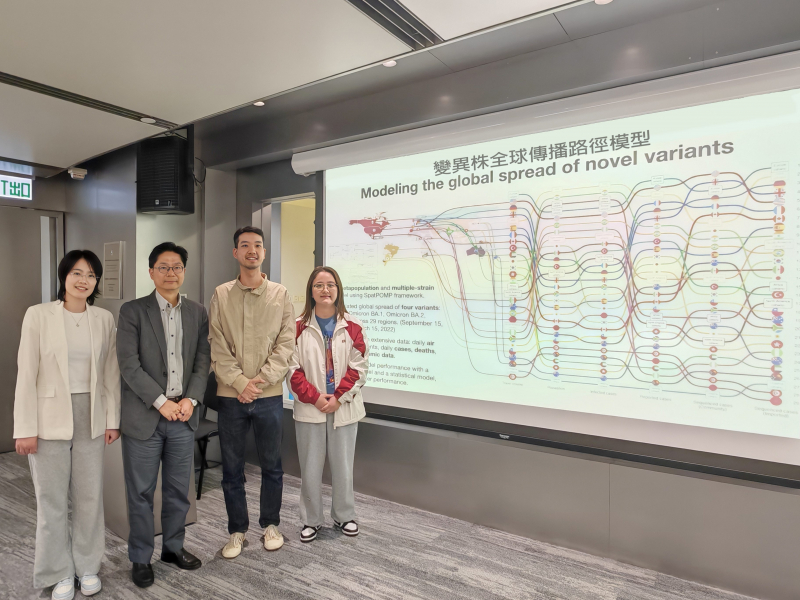
HKUMed study proposes targeted genomic surveillance strategy at key aviation hubs to detect viral variants faster. The research was led by Professor Leo Poon Lit-man (second left) and Dr Gu Haogao (second right).
A research team from the School of Public Health at the LKS Faculty of Medicine, the University of Hong Kong (HKUMed), has developed an innovative global viral genomic blueprint, showing that strategically targeting genomic surveillance on international travellers at two major aviation hubs could accelerate the detection of emerging viral variants by days, even with substantially limited global resources. The findings were published in Nature Communications [link to the publication], offering a practical pathway towards establishing a sustainable global early warning system for future pandemics.
During the COVID-19 pandemic, genomic surveillance—through sequencing viral samples to track virus evolution and spread—proved essential for detecting variants like Omicron and guiding updates to diagnostics and vaccines. However, maintaining pandemic-level surveillance over a long period requires substantial investments in human resources, funding and logistics, posing significant challenges for many countries and regions.
To address these challenges, the research team developed a genomic surveillance model that can be sustainably implemented even in resource-limited settings. Leveraging a model that integrates 9.5 million viral genomes, epidemiological data, and global air travel patterns, the research team reconstructed the global spread of the Omicron variant and simulated surveillance strategies for future threats.
Strategic use of limited resources to strengthen global early warning capabilities
The study found that strengthening viral surveillance among transit passengers at just two highly connected international aviation hubs—such as Hong Kong, China, and the United Arab Emirates (UAE)—could accelerate the global detection of emerging variants by approximately 2.6 to 3.3 days.
This approach is readily implementable, making it well suited for long-term adoption. Even when diagnostic or genomic sequencing capacity is reduced by more than 50%, the proposed surveillance strategies continue to outperform current monitoring approaches, thus demonstrating strong cost-effectiveness and real-world applicability.
The research team also evaluated the strategy under a range of epidemic scenarios and found that its effectiveness remained robust regardless of a variant’s transmissibility or the level of population immunity, highlighting the strategy’s potential as a resilient and scalable model for future pandemic preparedness.
Early detection, rapid response to emerging threats
Professor Leo Poon Lit-man, Daniel C K Yu Professor in Virology, and Chair Professor of Public Health Virology in the School of Public Health, HKUMed, said, ‘Even a lead time of just a few days can be crucial for laboratory and public health preparedness workflows. It gives laboratories extra time to assess whether existing diagnostic tests need updating, develop tools to evaluate immune escape, and begin vaccine prototype development before a variant becomes widespread. These measures would help public health authorities stay ahead of emerging threats.’
Professor Leo Poon emphasised, ‘Strengthening local surveillance in all regions remains the foundation of global health security. Our proposed strategy does not require redistributing resources from other regions. Instead, it leverages surveillance at only two busy international aviation hubs to capitalise on their existing capacity. This approach can establish an early warning system that benefits everyone, accelerating the detection of emerging viruses without compromising surveillance capacity elsewhere.’
Setting a new standard in infectious disease modelling
In addition to proposing an innovative surveillance strategy, the study represents a major methodological advance in infectious disease modelling. Professor Leo Poon explained, ‘The team developed a comprehensive metapopulation, multiple-strain model with exceptional temporal and spatial resolution, integrating high-quality diagnostic records, sequencing data, daily air travel movements, non-pharmaceutical intervention data and many phylogenetically inferred transmission cases. Using advanced calibration techniques, this approach provides a robust quantitative framework for evaluating the performance of various surveillance strategies, setting a new standard for evidence-based pandemic preparedness and response planning.’
About the research team
The research project was co-led by Professor Leo Poon Lit-man, Daniel C K Yu Professor in Virology, and Chair Professor of Public Health Virology in the School of Public Health, HKUMed, and Co-Director of The Hong Kong Jockey Club Global Health Institute (HKJCGHI), and Dr Gu Haogao, the first author. Other collaborators are from Texas A&M University, the United States, and the University of Melbourne, Australia.
About The Hong Kong Jockey Club Global Health Institute (HKJCGHI)
Established in 2024 with support from The Hong Kong Jockey Club Charities Trust, the HKJCGHI aims to enhance global pandemic preparedness through vaccine research, development and implementation. For more information, visit www.hkjcghi.org.
Acknowledgements
The research was supported by the Research Grants Council of the Government of the HKSAR, the InnoHK initiative of the Innovation and Technology Commission, and The Hong Kong Jockey Club Global Health Institute, Hong Kong, China.
Media enquiries
Please contact LKS Faculty of Medicine of the University of Hong Kong by email ([email protected]).
 Facebook
  HKU IOS App
  HKU Android App
  Social Media and Apps